

Posted In: Media by
Alex Moore,
November 9, 2026
By Alex Moore, Associate Director
The title isn’t mine, but it was one of the best lines of the day, which i’ll get to shortly.
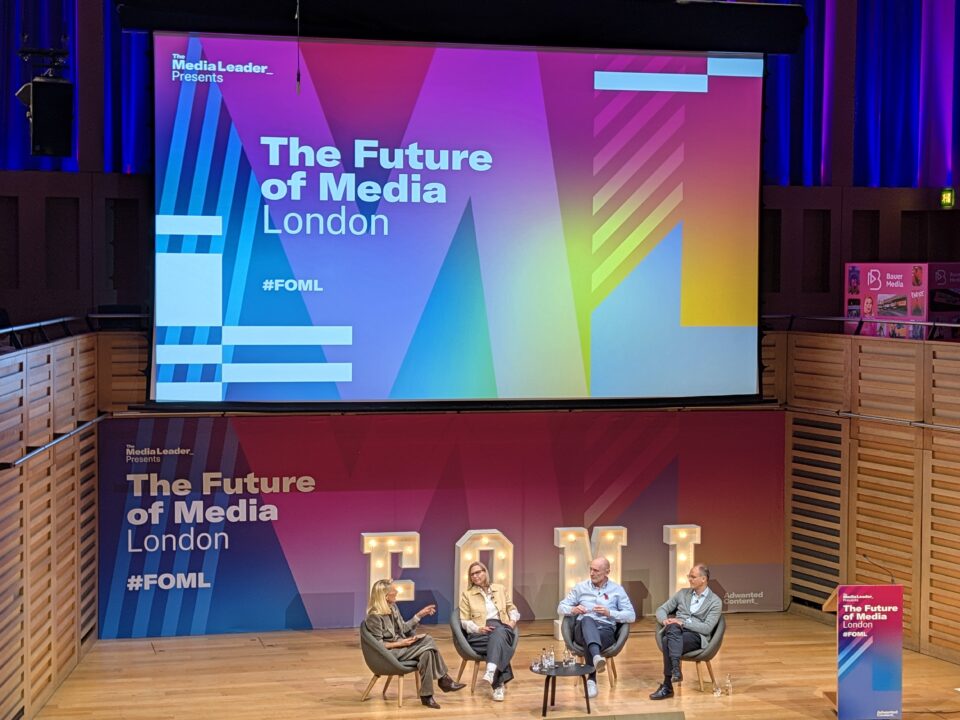
Last week I swapped Saw Mill Yard for King’s Place and headed down to The Future of Media London. The event, put on by The Media Leader and Adwanted, brings more than 1,000 people from agencies, brands, media owners, broadcasters and sponsors under one roof. In other words, loads of lanyards, free tote bags, plenty of chore jackets and quite a bit of, “I think I’m connected to them on LinkedIn?”.
Across the sessions there were three or four that properly stuck with me. They had me furiously scribbling in my notepad, and voicenoting myself on the train home so I didn’t forget anything (I know, I know, I’m sorry). Some of it softly challenged current thinking, and plenty of it reaffirmed what we’ve been saying and seeing at Boutique for a while now. Here’s what I took back up to Yorkshire.
Apologies for the slightly stretched analogy, but the panel I’ve thought about most since asked “Is TV the new performance channel?” and dug into the dangers of a diet of pure performance media. Jason Brownlee from Colourtext hosted, with Deirdre Mc Gettrick from ufurnish.com, Lesley Myers-Lamptey and Max Toulliou from WPP Media, and Liz Duff from Mediaplus UK. Jason opened up discussing the dreaded performance plateau: hard-wording, easy to measure digital, but one day the CMO decides to invest another £50k into search and this time looks on as the needle refuse to move.
It’s not new news, but handily it’s a conversation we have with clients almost every week. Performance channels are absolutely brilliant at catching the people who are ready to buy today, but time and time again, they struggle to create new demand. Lean on them too hard for too long and costs creep up, volumes flatten, and next year’s customers never hear your name. Then everyone ends up staring at the dashboard wondering what’s gone wrong.
The evidence has been there for years. Les Binet and Peter Field showed that the brands that grow balance long-term brand building with short-term activation, and TV is still one of the best ways to do the former at scale. I’d go a step further: even the phrasing of brand and performance is a misnomer, every touchpoint should be pulling in the same direction, towards where the business actually wants to go.
The trouble is, real people don’t behave like attribution models. Nobody sees an ad on their TV (is it linear? BVOD? SVOD? AVOD? Does a consumer care?), consciously feels something, then politely clicks the last-click link so we can take the credit. As an industry the obsession measuring every penny is real, and that pushes brands into short-term thinking that quietly holds them back. Besides, the board rarely asks about Meta or Google clicks, but whether we’re going to hit that quarters numbers.
It’s not our job isn’t to tell a client to rip up their plan but rather meet them halfway: keep what’s working, find a lower-risk way to test new channels alongside it, and give them the ammunition to take the case to their board.
One of my favourite talks came from Hamid Habib, Managing Director of Arena Media UK and an old colleague of mine from Starcom. He explained, gracefully as ever, how creativity is slowly being stripped out of media planning. As he put it, “if you plan to the average today, you’re planning to nobody”.
He’s spot on. A lot of planning has quietly turned into an optimisation exercise: hit the reach, squeeze the CPM, export the spreadsheet and pat each other on the back. It’s efficient, but it’s also how media ends up as wallpaper, with plenty of activity and not much direction. The work that cuts through comes from thinking differently about where and how a brand turns up.
Hamid also talked about community, and that really chimed with me. People are herd creatures. We want to belong and fit in, while still feeling a little bit distinctive. The brands that win earn a genuine place in the communities their audience already cares about, rather than just renting space in front of them.
Events like this are a good reminder of what an amazing industry we work in.
For me, the thread running through it all was simple. Most brands have more growth in them than their marketing is finding. The ones that find it are brave enough to think beyond the next click, and backed by partners who genuinely care how they get there. That’s what we try to do every day: help brands find growth, wherever it comes from.
A big thank you to the teams at The Media Leader and Adwanted for hosting. Pulling off an event this size is no small feat, and it ran incredibly smoothly compared with some I’ve been to.
I’d also like to raise a toast to the independent agencies and indie speakers who were given a proper platform. I was gutted to miss day two of TFOML, and the Challenger Stage, but I’m proud to have played a very small part in shaping the two days. There has been some spicy discourse across the trade press, and LinkedIn over the last few months but it’s encouraging to see so much excitement around the indie movement, even with certain holding-company panel guests doing their best to counter the agile groundswell. Quite comically at times, in fact.
We’re very serious about our work. So if any of this has got you thinking, I’d love to grab a coffee and talk it through. I’m more than happy to come to you.

 Privacy Policy


